 Dear
Dick Dear
Dick
Thank you for your most interesting letter; you have quite a library
of aircraft books. I have read quite a few but nowhere near as many
as you have.
You say you would love to fly in a Lancaster. Well, if ever you do you
would be amazed at the tremendous noise level. We were young and did
not know any different but the times in the 1950s when I occasionally
flew Lancasterians I didn’t like it a bit. Even the Yorks were
very noisy and they had a little soundproofing in the passenger cabin.
Nowadays the passengers can quietly talk to each other, watch movies!
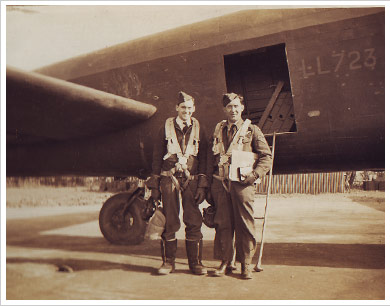
Sadly, the type of Lancaster I flew in wartime was not preserved after
the war. They were Lancaster Mk II, and had air-cooled radial engines
– Bristol Hercules – instead of the Merlin liquid-cooled
in-line engine. They were built as a precaution against the supply of
Merlin engines becoming a problem as so many fighter aircraft were using
the same engine. However a contract to build the Merlin in USA was signed
so there was no shortage after all, so they stopped making the Lancaster
II in 1944 after 300 were completed. All the crews who used the Lancaster
II were very fond of them; they were a good deal faster as they had
nearly 800 HP in total, l more than either the Lanc I or III. This was
very useful in war situations, and when you were taking off with a full
load there were no worries about whether or not you would make it. Also
they were quieter engines; the Merlin has a very ‘staccato’
bark. BOAC bought quite a lot of Canadian airliners from Canada in the
1960s. They were basically DC4 (Douglas) airframes but fitted with Merlin
engines instead of the usual Pratt and Whitney’s. These aircraft
were pressurised (the standard DC4 was not) so could fly higher altitudes
which suited the Merlin engine very well. However, the airliners were
incredibly noisy and it was very fatiguing as a passenger especially
on long flights. Much work was done to try and reduce the noise; eventually
Rolls-Royce had to completely alter the exhaust system. Instead of the
original design of an exhaust stack on each side of the engine, the
inboard (facing cabin) side exhaust was led over the top of the engine,
so all the exhaust noise was on the far side of the engines. This was
much better but costly and also reduced the power. Nowadays of course
it is all jet power – and all the noise comes out at the rear
and the passengers never hear it!
Talking about jets, the Lancaster was used quite a lot as a flying test
bed for the early jet engines. Even big engines got all their reliability
and safety certificates through flying either strapped underneath the
bomb bay or installed in the wing of Lancaster bombing aircraft. Of
course, after the war there were hundreds of them cut up for scrap metal
or sold to foreign companies very cheaply. I remember flying, whilst
still in the RAF, Lancasters up to an old airfield in north-west England
where we used to park them in rows. A firm of contractors called Wimpey
had lorry loads of gas bottles, and men were cutting off the engines
etc with oxy-acetylene torches and loading the aluminium etc. to the
smelters. It was very sad for me to see aircraft just torched like that.
The funny thing is that now you cannot buy an old Merlin engine - a
warehouse full of them would make you a millionaire!
After obtaining my civil licences my first employment was with British
South American Airways. They only flew to Brazil, Argentina, Panama,
Lima and Chile. The only aeroplane at that time which had the range
to fly so far was the Lancaster. The American aircraft like the Constellation
would have been ideal but was in short supply and very expensive. So
we had Lancasters converted with a new nose, the bomb bay sealed up
for luggage and a single row of only 9 or 10 seats down the fuselage.
There was a tiny kitchen for the stewardess and really it could not
possibly make a profit, but kept the airline in business until better
aircraft were available. These were used on the long-distance routes:
London – Lisbon – Azores - Bermuda. We had shorter range
York aircraft which went across the South Atlantic via West Africa,
across to Recife in Brazil and down through Rio de Janeiro to Buenos
Aires. A Lancastrian would fly across the Andes from Buenos Aires to
Lima once weekly. One of these Lancs was lost over the Andes and only
found a few months ago after 54 years! Nothing lasts forever, of course,
and it is amazing that two Lancasters are still flying after so long.
When the Berlin airlift started the company bought some Tudor V aircraft
that were not certified for passenger flying after the two Tudor disasters
in the South Atlantic. These Tudor Vs were very large tailwheel aircraft,
powered by Merlin 600 series engines. The crew was pilot, engineer and
radio officer, and the long fuselage was filled with aircraft wing fuel
tanks. We flew from Wunstorf airfield, near Hanover, to Gatow in Berlin.
The duty period was normally 3 round trips to Gatow and back to Wunstorf.
It was about 1 hour 40 mins there, and 1 hour 20 mins back, with about
30 minutes to offload and 40 minutes to fill up again; so it was quite
a tough day. Looking at my logbook, I see a typical day’s work:
07:30 – 08:51 then 09:20 – 10:35, that’s the first
lift. 11:17 – 12:47, then 13:05 – 14:15 that’s the
second, 14:53 – 16:21, then 16:46 – 17:57, that’s
the day’s work done, 28.4.49. The next day’s first lift
was 19:23, so worked all night the next duty. So it went on for about
3 weeks, then we had a week off back in England. The airlift finally
ended in August 1949, and I was transferred to British Overseas Airways
on the Constellation fleet.
|